
How Much Does a Steel Flange Weigh? Formula and Calculator
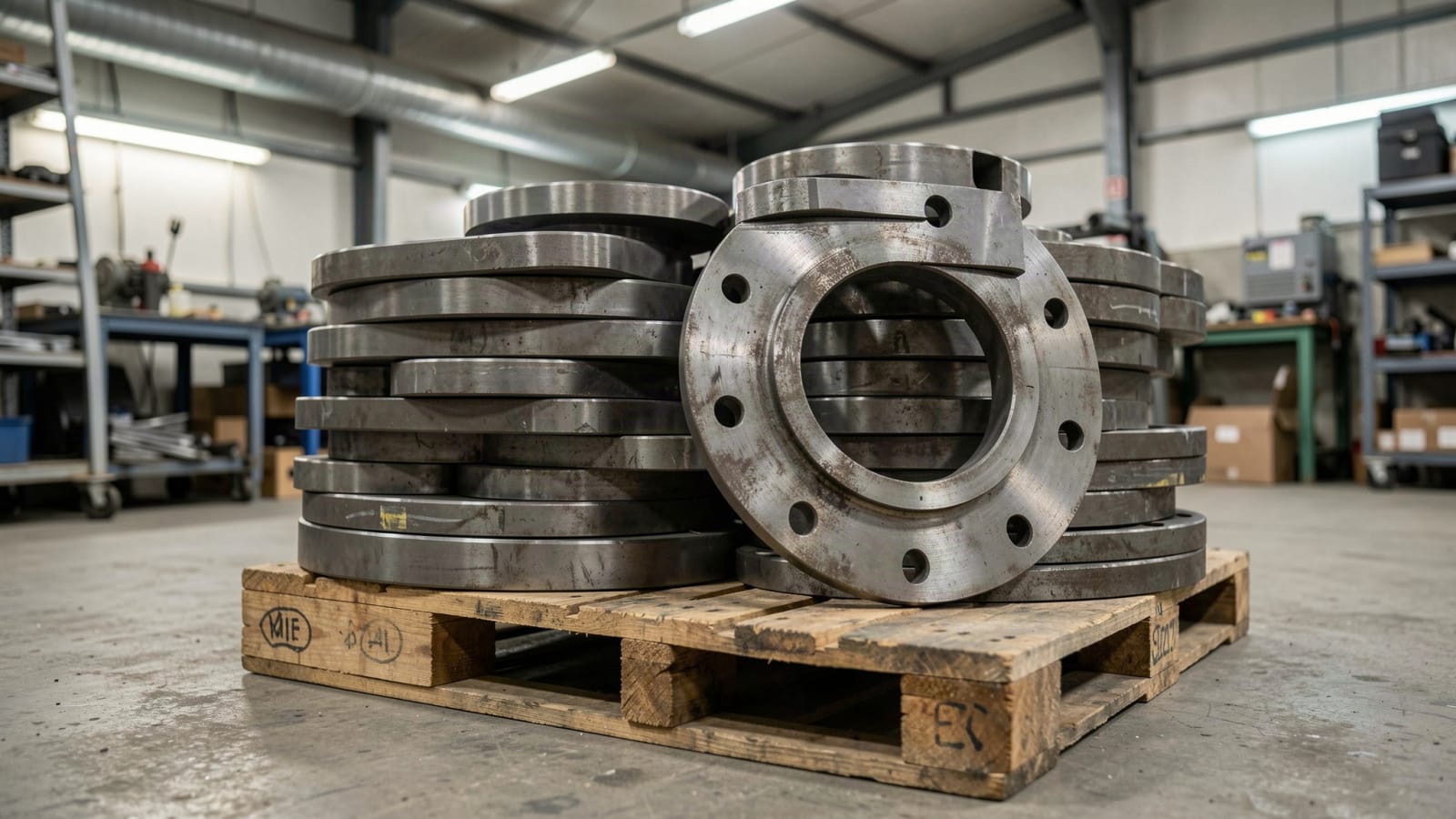
How Much Does a Steel Flange Weigh? Formula and Calculator
Flange weight decides shipping costs, crane picks and material quotes — and it is one of the easiest things in piping to calculate yourself. Here is the geometry, a worked example, and the shortcuts.
The formula
A plate flange is a disc with a bore and a ring of bolt holes. Its steel volume is:
- Disc: V = π/4 × (D² − d²) × t
- Minus bolt holes: n × π/4 × d_b² × t
where D = outside diameter, d = bore, t = thickness, n = number of bolt holes, d_b = bolt-hole diameter. Multiply the volume by density (7.85 g/cm³ for carbon steel, 7.9–8.0 for stainless) and you have the weight.
Worked example — DN100 plate flange
Take a typical DN100 PN16 plate flange: D = 220 mm, bore d = 116 mm, t = 20 mm, with 8 bolt holes of 18 mm:
- Disc: π/4 × (220² − 116²) × 20 ≈ 548,900 mm³ ≈ 549 cm³
- Bolt holes: 8 × π/4 × 18² × 20 ≈ 40,700 mm³ ≈ 41 cm³
- Net volume: ≈ 508 cm³ → × 7.85 g/cm³ ≈ 4.0 kg
The bolt holes took off ~7% — worth including when you are pricing a pallet of 200 flanges, irrelevant when you are lifting one.
What moves the weight
- Diameter dominates — weight grows with D², so a DN200 flange is roughly 4× a DN100 of the same thickness, not 2×.
- Pressure class — PN40 flanges are thicker and wider than PN16 at the same DN; expect 1.5–2.5× the weight.
- Type — a weld-neck flange adds the conical hub, a blind flange has no bore (heavier), a slip-on sits between. The plate-flange formula above is the floor, not the ceiling.
- Material — stainless (+1–2%), aluminum (−65%), brass (+8%) versus carbon steel: same geometry, different density.
Skip the arithmetic
Our flange weight calculator runs exactly this geometry — enter OD, bore, thickness, bolt circle and hole count, pick a material, and it returns the weight per piece and per batch. For the material side, densities for 30+ alloys are in the materials database, and any non-flange shape (ring, disc, bar, tube) is covered by the metal weight calculator.
Quick reference habits
- Quoting many sizes? Weigh one real flange per size and calibrate — catalog weights vary a few percent between manufacturers because of hub and facing differences.
- For raised-face flanges the raised face adds well under 1% — ignore it at quoting precision.
- Always state the standard (EN 1092-1, ASME B16.5) in the quote; the "same" DN100 differs between them.