
IPE vs HEA vs HEB: How to Choose the Right Steel Beam
IPE vs HEA vs HEB: How to Choose the Right Steel Beam
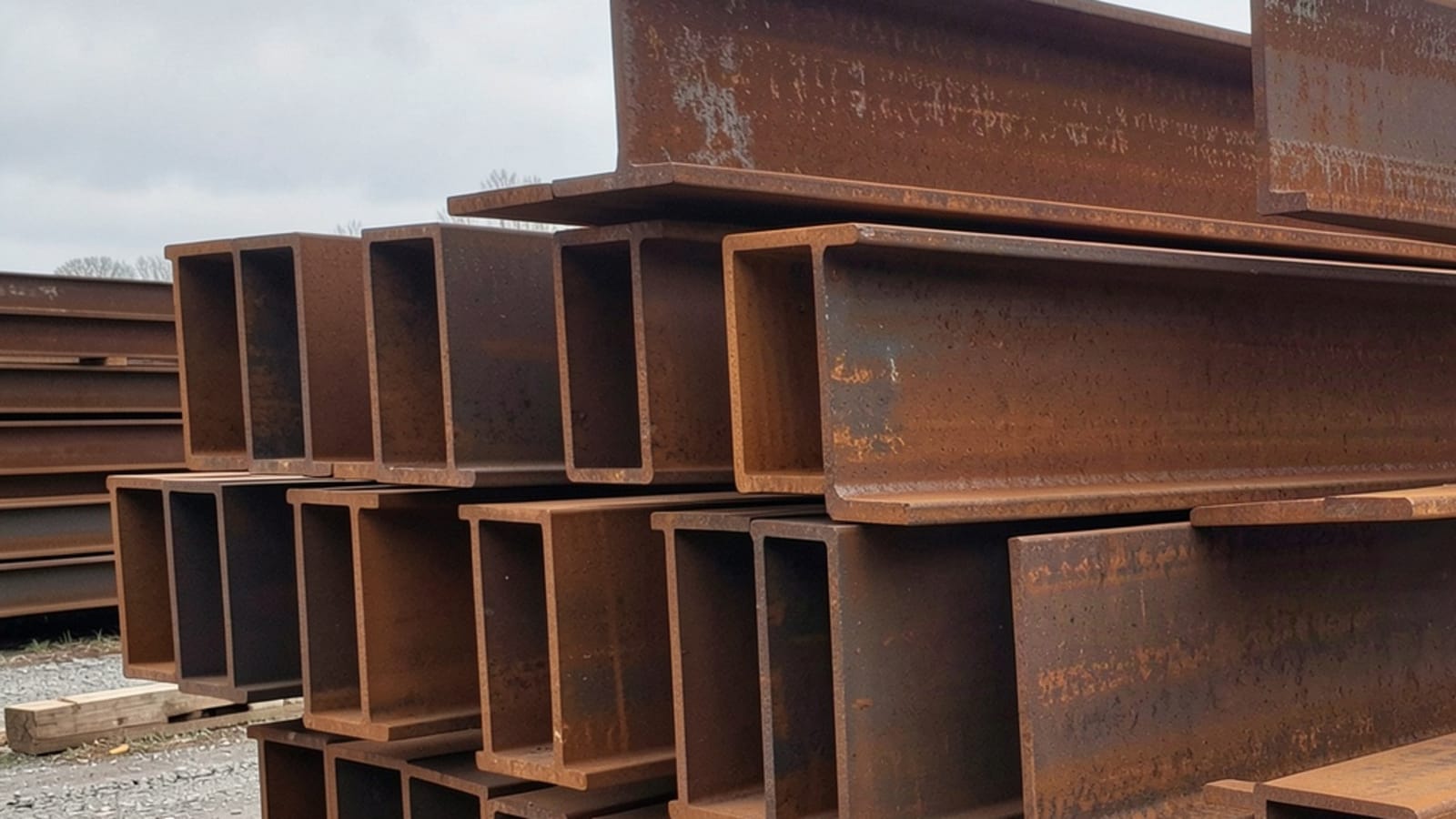
Walk into any European steel yard and you will find three families of hot-rolled beams: narrow IPE sections, and the wide-flange HEA and HEB series. They look similar on paper — all are double-T shapes — but picking the wrong family for the job either wastes steel or wastes headroom. Here is how to choose, with real numbers.
The short answer
- IPE — the default for bending (floor beams, purlins, lintels) when construction depth is not limited. For a required stiffness, a taller IPE is almost always the lightest and cheapest option.
- HEA / HEB — when depth is capped, when the member is a column, or when loads act about both axes. The wide flanges pack stiffness into less height and are far stronger about the weak axis.
- HEA vs HEB — same widths, different thicknesses: HEA is the light series, HEB the standard/stocky one. If HEA passes your checks, it saves 20–30% weight over HEB.
What the numbers say at the same nominal size
Take nominal size 200 (IPE 200, HEA 200, HEB 200):
- IPE 200: 200 mm tall, 100 mm wide — 22.4 kg/m, Ix = 1,943 cm⁴, Iy = 142 cm⁴
- HEA 200: 190 mm tall, 200 mm wide — 42.3 kg/m, Ix = 3,692 cm⁴, Iy = 1,336 cm⁴
- HEB 200: 200 mm tall, 200 mm wide — 61.3 kg/m, Ix = 5,696 cm⁴, Iy = 2,003 cm⁴
At the same nominal size the wide-flange sections are two to three times heavier — and two to three times stiffer. Comparing at equal size tells you little. The engineering question is different: what is the lightest section that gives me the stiffness I need?
The comparison that actually matters: same stiffness
Say your beam needs roughly Ix ≈ 8,000 cm⁴. Three candidates deliver it:
- IPE 300 — Ix = 8,356 cm⁴ at 42.2 kg/m (300 mm deep)
- HEA 240 — Ix = 7,763 cm⁴ at 60.3 kg/m (230 mm deep)
- HEB 220 — Ix = 8,091 cm⁴ at 71.5 kg/m (220 mm deep)
Over a 12 m bar that is 506 kg vs 724 kg vs 858 kg of steel for the same job. The IPE saves 30–40% of the material — if you can afford 70–80 mm of extra depth. That is the entire IPE-vs-HE decision in one example:
- Depth is free → IPE wins on cost.
- Depth is capped (integrated ceilings, door headers, machine frames) → HEB does the same work in 220 mm.
When the wide flange wins regardless
Columns. Buckling is governed by the weak axis, and here the difference is dramatic: IPE 300 has Iy = 604 cm⁴, while HEB 300 has Iy = 8,563 cm⁴ — 14 times more. This is why you see HEA/HEB columns and IPE beams in the same frame, almost never the reverse.
- Biaxial bending — crane runways, corner posts, members loaded sideways: wide flanges handle it, narrow IPEs do not.
- Lateral-torsional buckling — long unbraced spans twist sideways before they yield; wide flanges are much more stable.
- Connections — a 200 mm flange gives room for bolt groups that a 100 mm IPE flange simply does not have.
HEA or HEB?
Same outside widths, different flange/web thicknesses. HEA 300 weighs 88.3 kg/m (Ix = 18,260 cm⁴); HEB 300 weighs 117 kg/m (Ix = 25,170 cm⁴). Start with HEA — if it passes your deflection and stress checks, you save roughly a quarter of the steel. Move to HEB when checks fail by a little, or when connections need the thicker flange. (There is also the reinforced HEM series for extreme cases.)
Quick rules of thumb
- Simple floor beam, no height limit → IPE with depth ≈ span/20 to span/25
- Beam depth capped → HEA/HEB one or two sizes smaller in height
- Column → HEA/HEB, never IPE if you can avoid it
- Both directions loaded → HEA/HEB
- Doubt between HEA and HEB → check HEA first, it is usually enough
Check your case in two minutes
Every size links to a full data sheet in our steel profile tables — dimensions, weights, and section properties for all 128 sizes. Then run your exact span, load, and support case through the free beam deflection calculator to see deflection, stress, and the L/360 check instantly.
Preliminary sizing only — final member design must be verified to Eurocode 3 (or your local code) by a qualified engineer, including buckling, shear, and connection checks.