
SHS vs RHS vs CHS: Which Hollow Section Should You Use?
SHS vs RHS vs CHS: Which Hollow Section Should You Use?
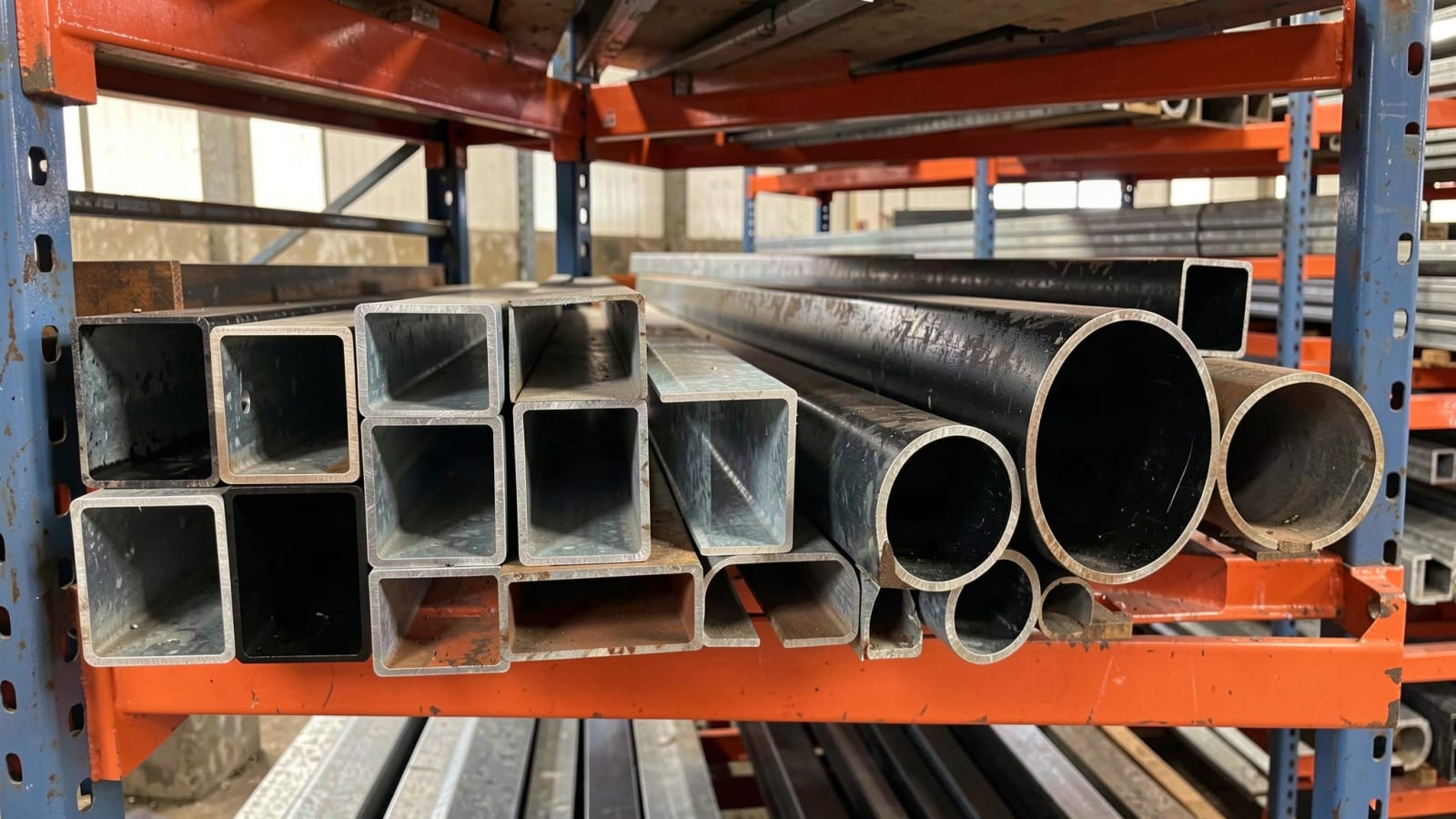
Structural hollow sections come in three shapes: square (SHS), rectangular (RHS) and circular (CHS). All three are closed sections — enormously better in torsion than open profiles like I-beams — but they are not interchangeable. Here is how to pick, with real EN 10219 numbers.
The short answer
- RHS — the default for bending in one direction: floor joists, lintels, trailer chassis, machine frames. Put the long side vertical and you get the most stiffness per kilogram of the three.
- SHS — for columns, posts and frames loaded from any direction. Same stiffness both ways, clean look, easy square cuts and joints.
- CHS — for torsion, wind and aesthetics: handrails, masts, roll cages, trusses with welded nodes. Best torsional behavior and no sharp corners, but harder to join to flat faces.
What the numbers say
Compare three sections of similar weight (all EN 10219, S355 typical):
- RHS 200×100×5 — 22.3 kg/m, strong axis Ix = 1,459 cm⁴, weak axis Iy = 497 cm⁴
- SHS 100×100×5 — 14.4 kg/m, Ix = Iy = 271 cm⁴
- CHS 114.3×5 — 13.5 kg/m, I = 257 cm⁴ every direction
The RHS carries almost 3× the bending stiffness of its own weak axis in the strong direction — that asymmetry is exactly what you want in a beam and exactly what you don't want in a free-standing column. The SHS and CHS trade peak stiffness for symmetry.
Beam duty: why RHS wins
For a simply supported span, deflection scales with 1/Ix. Orienting an RHS 200×100 with the 200 mm side vertical gives Ix = 1,459 cm⁴; laid flat it drops to 497 cm⁴ — the same steel is three times more flexible. Rules of thumb:
- Span limited by deflection → choose the deepest RHS that fits, thinnest wall that passes.
- A taller thin-wall RHS usually beats a squatter thick-wall one on weight: RHS 150×100×5 (18.3 kg/m, Ix = 719 cm⁴) out-stiffens SHS 100×100×8 at similar weight.
- Check your span and load in the beam deflection calculator — it has SHS/RHS/CHS profile presets built in.
Column and frame duty: why SHS wins
Columns buckle about the weakest axis, so a section with one weak axis wastes material. An SHS has the same radius of gyration in every direction, and its flat faces make bolted base plates, cleats and cross-bracing simple. That is why machine frames, balustrade posts and building columns default to SHS.
Torsion and wind: why CHS wins
A closed round section is the theoretical optimum for torsion — the CHS puts every millimetre of steel at the same distance from the center. It also has the lowest drag coefficient, which matters for masts, sign posts and exposed members. The price: coping (saddle-cutting) tube-to-tube joints takes more fabrication effort than square cuts on SHS/RHS.
Wall thickness: the quiet variable
Each size comes in several walls, and the spread is large: SHS 100×100 runs from 9.0 kg/m with Ix = 177 cm⁴ (t = 3) to 21.4 kg/m with Ix = 366 cm⁴ (t = 8). Note what happened: 2.4× the steel bought only 2.1× the stiffness — extra wall adds material near the centroid where it works least. If deflection governs, go bigger, not thicker; if bearing, crushing or weld throat governs, go thicker.
Where to find the numbers
Our steel profile tables now include the full EN 10219 program: SHS (18 sizes), RHS (16 sizes) and CHS (16 sizes) — every standard wall thickness with weight, area, Ix/Wx and radius of gyration, plus a worked deflection example per size. For a custom section or a different alloy, the metal weight calculator covers 30+ materials.
Preliminary sizing only — final member design belongs to Eurocode 3 (or your local code) checks by a qualified engineer, including buckling, shear and joint verification.