
Bend Allowance, Bend Deduction & K-Factor Explained
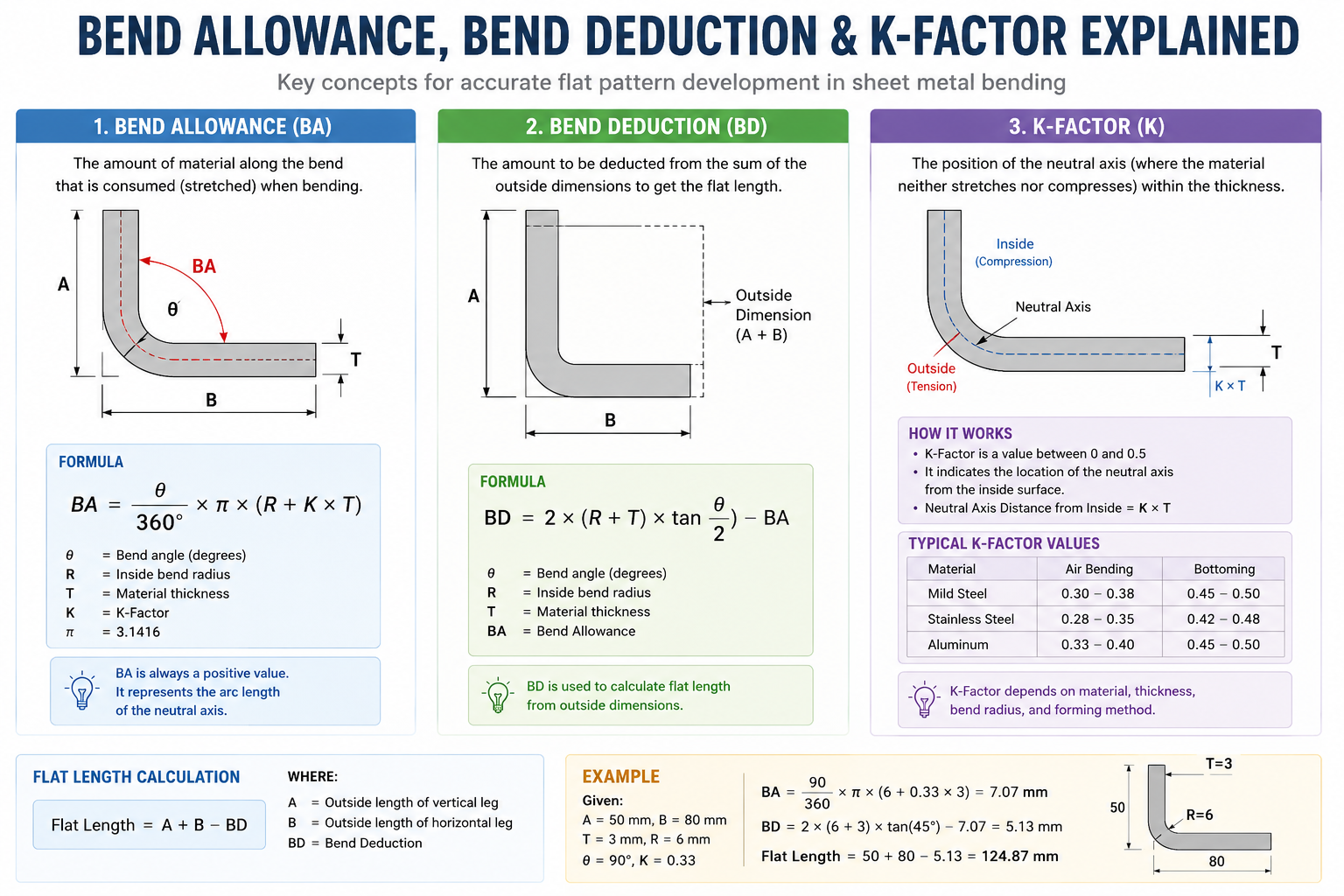
Bend Allowance, Bend Deduction & K-Factor Explained
When you bend sheet metal, the material stretches on the outside and compresses on the inside. That means the flat blank is not simply the sum of the outside dimensions — you have to account for what happens in the bend. This is where bend allowance, bend deduction, setback and the K-factor come in.
To skip the math, drop your numbers into our free bend allowance calculator — it returns the developed (flat) length instantly.
The neutral axis and the K-factor
During bending, one layer neither stretches nor compresses: the neutral axis. The K-factor tells you where it sits, as a fraction of the material thickness:
K = distance of neutral axis from inside surface ÷ thickness (t)
Typical values:
A larger inner radius pushes the K-factor higher (toward 0.5).
Bend allowance (BA)
Bend allowance is the arc length of the neutral axis through the bend — the material "consumed" by bending:
BA = (π / 180) × A × (R + K × t)
Where A = bend angle (degrees), R = inside radius, t = thickness.
Bend deduction (BD) and setback
The flat length can be found two ways. Using bend deduction:
Flat length = sum of outside flange lengths − BD
Where BD relates to setback (SB), the distance from the bend tangent to the apex:
SB = (R + t) × tan(A / 2), and BD = 2 × SB − BA
Most CAD and CAM systems let you enter a K-factor or a bend-deduction table; getting it right is what makes your flat pattern match the finished part.
Why it matters
Cut the blank wrong and every downstream step is off. Even a 0.5 mm error per bend adds up across a multi-bend part. Once you have the tonnage sorted (see our press brake tonnage guide), the flat pattern is the other half of a right-first-time bend.
Frequently Asked Questions
What is the K-factor in sheet metal?
It's the ratio of the neutral-axis position to the material thickness. It typically ranges from 0.33 to 0.5, rising with a larger inside radius.
What's the difference between bend allowance and bend deduction?
Bend allowance is added to the flat sections (the arc length consumed by the bend); bend deduction is subtracted from the sum of the outside dimensions. Both give the same flat length.
How do I calculate the flat pattern length?
Flat length = sum of outside flanges − bend deduction, or sum of flat sections + bend allowance. Our calculator does either from thickness, radius, angle and K-factor.
What K-factor should I use for mild steel?
Around 0.40–0.45 for a medium inside radius. Confirm against your own test bends for critical work