
Sheet Metal Gauge to mm Conversion (Steel, Galvanized, Stainless, Aluminum)
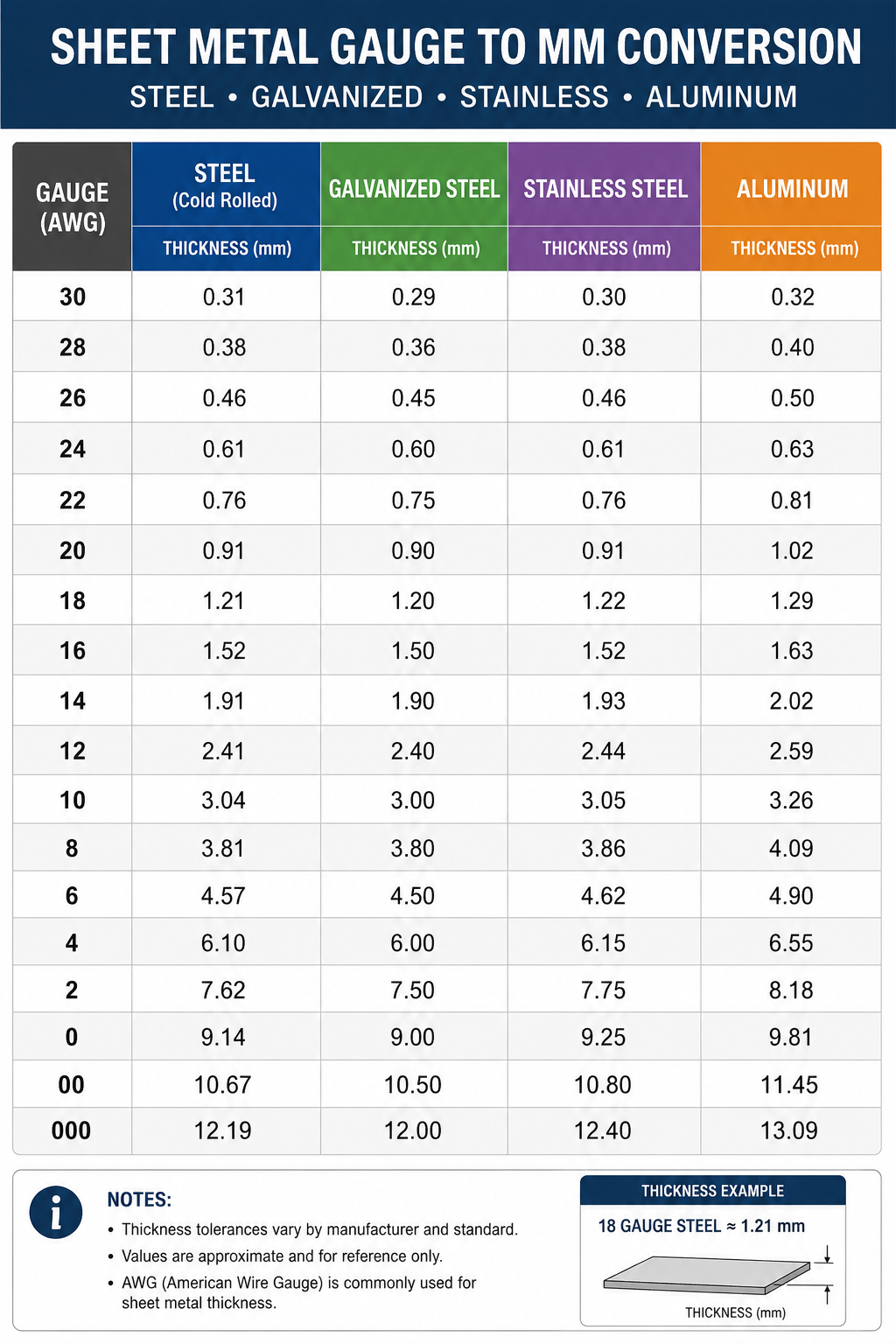
Sheet Metal Gauge to mm Conversion (Steel, Galvanized, Stainless, Aluminum)
Sheet metal "gauge" is one of the most confusing conventions in the trade: a single gauge number means different thicknesses depending on the material, and the numbers run backwards — higher gauge means thinner metal. This guide clears it up and gives you the conversions.
For instant lookups in both directions (and weight per m²), use our free sheet metal gauge chart & converter.
Why higher gauge means thinner metal
The system comes from wire drawing: the gauge number roughly matched the number of drawing passes. More passes = thinner wire = higher number. Sheet gauges inherited the convention, so 16 gauge is thicker than 20 gauge.
Why the material matters
There isn't one universal gauge scale:
- Steel & stainless use the Manufacturers' Standard Gauge (based on weight).
- Galvanized steel is slightly thicker than bare steel at the same gauge (it includes the zinc coating).
- Aluminum uses the Brown & Sharpe (AWG) scale, which is different again.
So "16 gauge" is not a fixed thickness — you must know the metal.
Gauge to mm — quick chart
Always confirm the material system when ordering — a "16 gauge" order in the wrong scale can be 0.3 mm off.
From thickness to weight
Once you know the thickness, the weight per square meter follows from the material density. If you're estimating material cost, feed the thickness straight into our metal weight calculator or the sheet metal weight calculator.
Frequently Asked Questions
What thickness is 16 gauge steel?
16 gauge mild steel is 1.52 mm (0.0598 in). In galvanized it's ~1.61 mm, in stainless ~1.59 mm, and in aluminum ~1.29 mm.
Why do gauge numbers get smaller as the metal gets thicker?
The scale descends from wire drawing, where the number counted drawing passes — more passes made thinner wire with a higher number.
Is gauge the same for steel and aluminum?
No. Steel and stainless use the Manufacturers' Standard Gauge; aluminum uses the AWG (Brown & Sharpe) scale, so the same number is a different thickness.
How do I convert gauge to mm quickly?
Use a gauge chart for the specific material, or our two-way gauge converter, which also shows weight per m².