
Press Brake Tonnage Chart: How to Calculate Bending Force
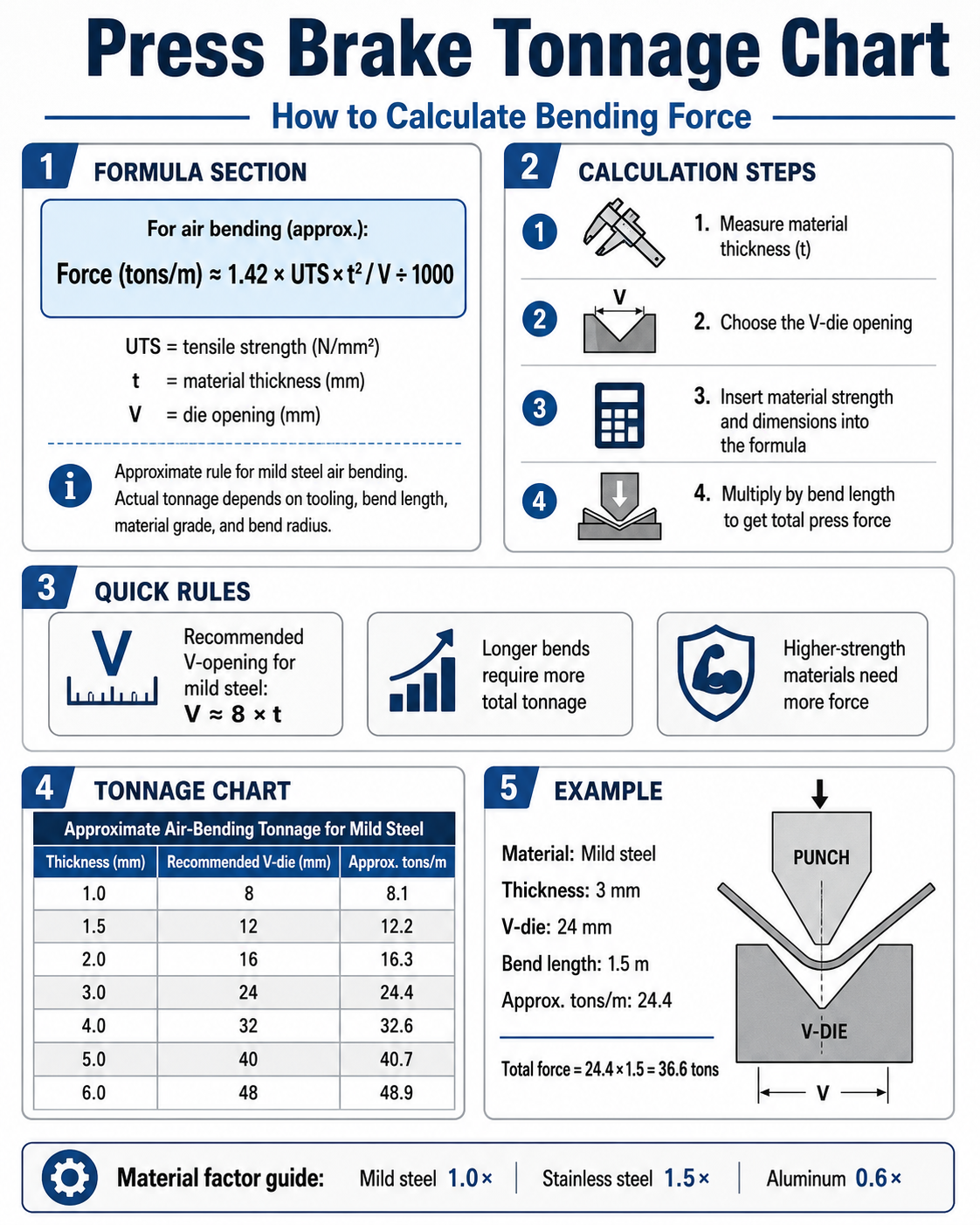
Press Brake Tonnage Chart: How to Calculate Bending Force
Choosing the right press brake tonnage is the difference between a clean bend and a cracked part, a jammed ram, or an overloaded machine. This guide explains how bending force is calculated for air bending, the die-opening rule that drives it, and gives you a quick reference chart for mild steel.
Want the number instantly for your exact setup? Use our free press brake tonnage calculator — enter material, thickness, die opening and bend length and it returns the force in kN and tons.
The air-bending tonnage formula
For air bending, the required force per meter of bend length is:
F = (1.42 × Rm × t²) / V
Where:
- F = bending force (kN per meter of bend)
- Rm = material tensile strength (N/mm², ≈ 450 for mild steel)
- t = material thickness (mm)
- V = die (vee) opening (mm)
The force scales with the square of thickness — doubling the sheet thickness roughly quadruples the tonnage. It also drops as the die opening widens, which is why die selection matters so much.
The 8×T die-opening rule
As a starting point, the vee die opening is usually 6 to 10 times the material thickness, with 8×T as the common default. A 2 mm sheet → 16 mm die; a 4 mm sheet → ~32 mm die. A wider die lowers tonnage and reduces the risk of cracking, but increases the minimum flange length and the inside radius.
Quick tonnage chart (mild steel, air bending, 8×T die, per meter)
Multiply by your actual bend length. A 3 mm sheet bent over 1.5 m needs roughly 23 × 1.5 ≈ 35 tons.
Don't forget these factors
- Stainless steel needs about 1.5× the tonnage of mild steel; aluminum about 0.5×.
- Bottoming and coining need far more force than air bending (up to 3–5× and 5–8×).
- Always keep a safety margin and stay within your machine's rated capacity across the full bed.
Once you know the force, you'll also want the flat blank size — see our guide on bend allowance and K-factor to calculate the developed length before cutting.
Frequently Asked Questions
How do I calculate press brake tonnage?
Use F = (1.42 × Rm × t²) / V per meter of bend, then multiply by bend length. Rm is the tensile strength (~450 N/mm² for mild steel), t is thickness, V is the die opening. Our tonnage calculator does this instantly.
What die opening should I use?
Start with 8× the material thickness. Use a wider die for thicker or harder material to reduce force and cracking; a narrower die gives a tighter radius but needs more tonnage.
How much more tonnage does stainless steel need?
Roughly 1.5× the force of mild steel for the same thickness and die, because of its higher tensile strength. Aluminum needs about half.
Does bend length affect tonnage?
Yes — the formula gives force per meter, so a longer bend needs proportionally more total tonnage.