
C-Channel Sizes: How to Read the Chart (And When to Use One)
C-Channel Sizes: How to Read the Chart (And When to Use One)
Channels are the quiet workhorse of every fab shop — stair stringers, trailer frames, equipment rails, lintels. Yet their designation system trips people up less often than W-beams only because fewer people read it carefully. Here is how American Standard channels work, and when a channel beats a beam.
The designation: exact, for once
A C10x15.3 is exactly 10.00 inches deep and weighs 15.3 pounds per foot. Unlike W-shapes — where a "W8" can be anywhere from 7.9 to 9.0 inches deep — C-channel depths never lie. Within a family, heavier sizes grow in flange width and web thickness while the depth stays fixed: a C10x30 is still 10.00 in deep, just with double the steel.
That makes channels pleasant to detail: swap a C10x15.3 for a C10x30 and every hole elevation survives.
The taper quirk
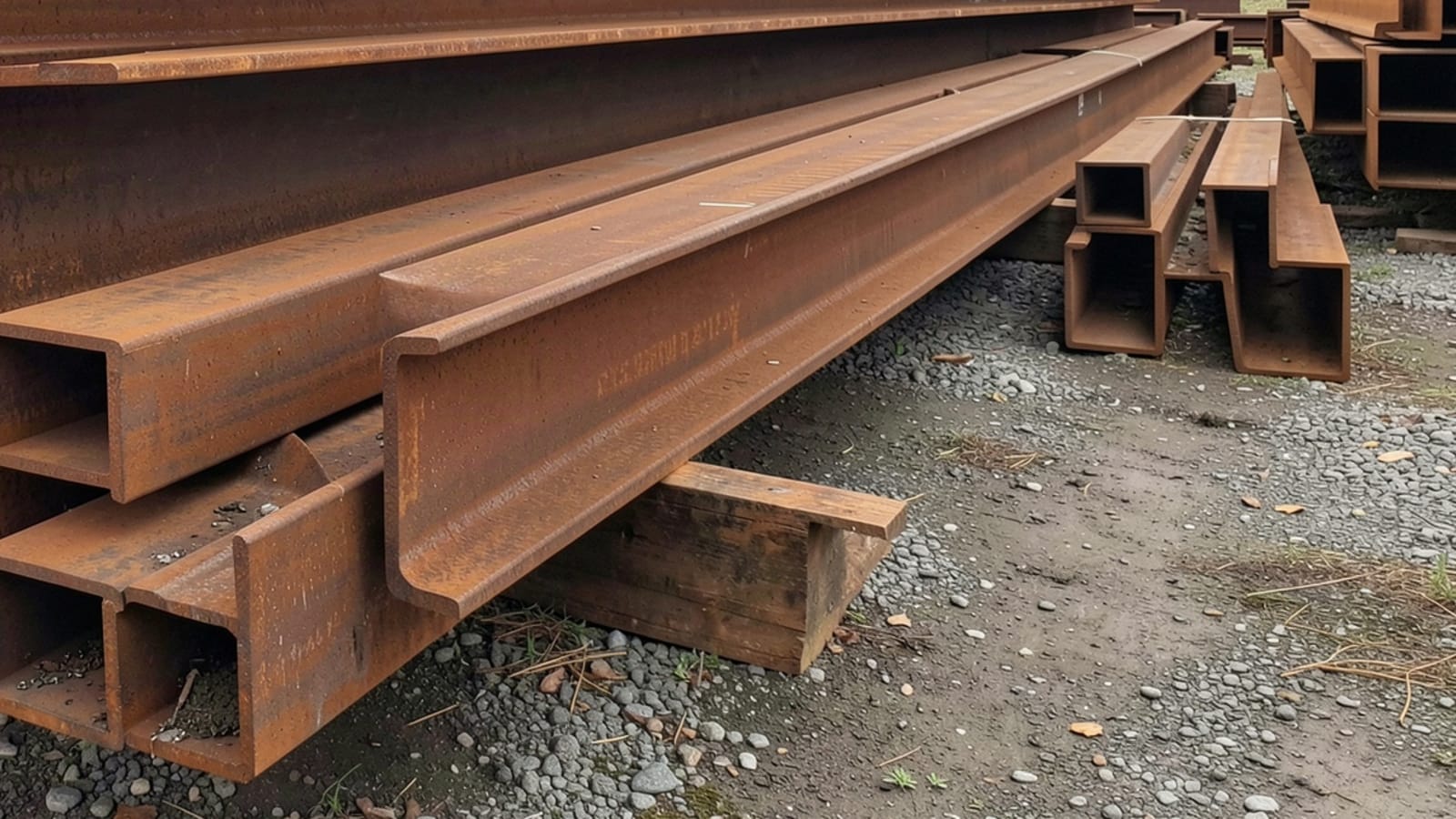
C-channel flanges taper at roughly 1:6 — thick at the web, thin at the tip. Catalog "flange thickness" is therefore an average (0.436 in for every C10, regardless of weight). If you're machining or bolting near the flange tip, remember the real thickness there is less. European UPE channels and American MC series offer parallel flanges when that matters.
When a channel beats a beam
- Flat back needed — against a wall, a web, another member. The channel's whole reason to exist.
- Stair stringers — the classic. A C12x20.7 stringer carries a typical residential flight with room to spare.
- Bolted built-up sections — two channels back-to-back make a clean I-shape you can unbolt later.
- Edge framing and rails — the smooth outer face and rounded toes are kind to hands and cargo.
The tradeoff: with all the flange on one side, channels are weak and twist-prone about their minor axis (ry as low as 0.4–0.9 in) — a C10x15.3 has Ix = 67.3 in⁴ but Iy of just 2.27 in⁴. Long unbraced channels need lateral restraint that an equivalent W-beam wouldn't.
C vs MC — a purchasing note
"MC" (miscellaneous channels) are not a heavier grade of C — they're a separate dimension series: deeper webs, wider flanges, oddball weights. C-channels are stocked at every service center; many MC sizes are mill-order items with real lead times. If a drawing calls for MC, check availability before you price the job.
Metric neighbors
The European relative is the UPN channel — same tapered-flange concept in metric sizes (a UPN 250 ≈ C10 territory). Not interchangeable in a design, but when you're translating drawings across markets, our UPN table and C-channel chart side by side get you to the closest equivalent in seconds.
The chart
The full C-channel chart covers all 29 standard sizes from C3x4.1 to C15x50 — depth, flange width, web thickness, weight, area, and section properties, each linking to a datasheet with metric conversions, bar weights, and a worked deflection example that opens directly in the beam calculator.