
How to Cut Steel Bars With Minimal Waste (Cutting Stock 101)
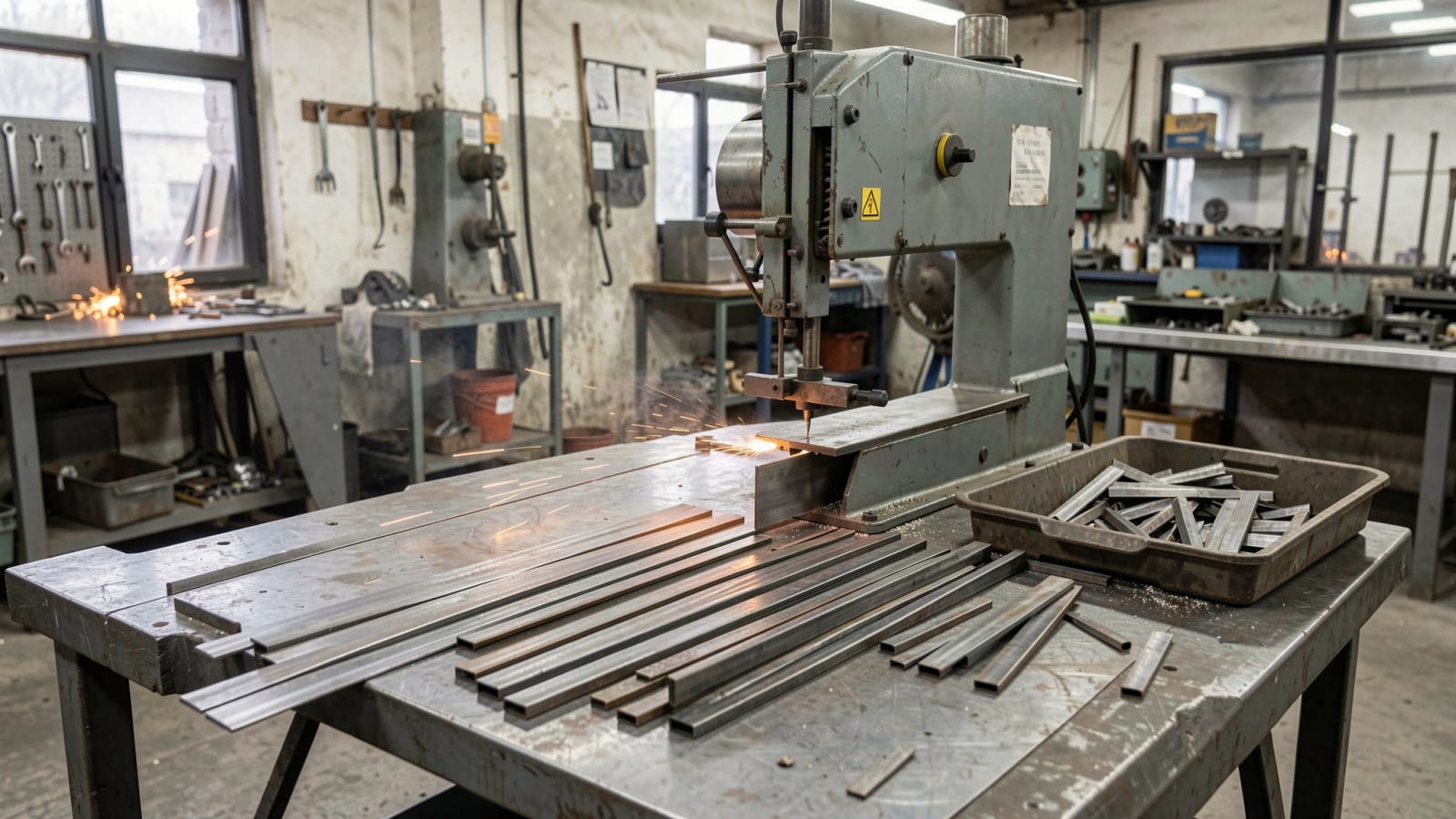
How to Cut Steel Bars With Minimal Waste (Cutting Stock 101)
Every fabricator knows the moment: a pile of 6-metre bars, a cut list of forty pieces, and the quiet certainty that whatever order you cut them in, the last bar will yield a 1.9 m offcut you'll trip over for a year. That problem has a name — the cutting stock problem — and getting it right is worth real money.
Why intuition fails
The obvious approach — cut the longest pieces first, fill gaps with short ones — is called First Fit Decreasing (FFD), and it is good: usually within a few percent of optimal. But "a few percent" of a €1,200 material order is a bar or two, and FFD has a known blind spot: it commits long pieces early and only then discovers that a slightly different pairing would have filled two bars exactly.
A quick example. Stock 6,000 mm, kerf ignored for clarity, cuts needed: 2× 2,800, 2× 1,900, 2× 1,300, 2× 1,200.
- FFD: bar 1 = 2,800 + 2,800 (rest 400); bar 2 = 1,900 + 1,900 + 1,300 (rest 900); bar 3 = 1,300 + 1,200 + 1,200 (rest 2,300). Three bars, 3.6 m scrap.
- Better plan: bar 1 = 2,800 + 1,900 + 1,300 (rest 0); bar 2 = 2,800 + 1,900 + 1,300 (rest 0); bar 3 = 1,200 + 1,200 (rest 3,600 — a usable half bar, or one fewer bar bought if 2.4 m stock exists). Same cuts, zero true scrap.
The better plan required spotting that 2,800 + 1,900 + 1,300 = 6,000 exactly — a subset-sum coincidence humans miss and computers don't.
What a real optimizer accounts for
- Kerf — every cut eats 2–4 mm (saw) or 1–2 mm (disc). Forty cuts on one bar is over a decimetre of vanished steel; plans that ignore kerf fail on the saw.
- End trim — mill ends are rarely square; serious shops trim 5–10 mm per bar end.
- Mixed stock lengths — 6 m and 12 m priced differently; sometimes the 12 m bar's better packing beats its handling premium.
- Usable offcuts — a 1.5 m remnant of a common profile is inventory, not scrap; a 300 mm one is scrap regardless.
Do it in the browser
Our cutting optimizer runs both strategies — fast FFD and an exact subset-sum search — and keeps whichever plan uses fewer bars, with kerf and stock length as inputs. You get a visual cut plan per bar, utilization percentage, and a printable shop sheet. It is free and the cut list never leaves your browser.
For sheet material the same logic goes 2D — guillotine cuts, plate utilization, remnant rectangles — in the plate cutting optimizer.
Habits that save material before optimization starts
- Batch similar jobs — one combined cut list packs far better than three small ones cut on different days.
- Standardize offcut bins — label remnants by profile and length; the optimizer only saves the offcut you can later find.
- Question the cut list — a 3,050 mm piece that could be 2,990 mm often unlocks a pairing (2,990 + 2,990 fits a 6 m bar; 3,050 + 3,050 does not).
- Weigh the plan — utilization % × bar weight tells you exactly what the scrap bin will hold; the metal weight calculator turns lengths into kilograms, and current scrap value comes from LME prices.